
The brushless DC (BLDC) motor’s increasing popularity is due to the use of electronic communication. That replaces the conventional mechanics comprised of brushes rubbing on the commutator to energize the windings in the armature of a DC motor.
Electronic commutation provides greater efficiency over conventional DC motors with improvements of 20 to 30% for electric motors running at the same Speed and load.
Further, the BLDC motor is more durable. It retains its high performance while the efficiency and power of an equivalent conventional motor decline due to wear, causing poor brush contact, arcing between the brushes and the commutator dissipating energy, and dirt compromising electrical conductivity.
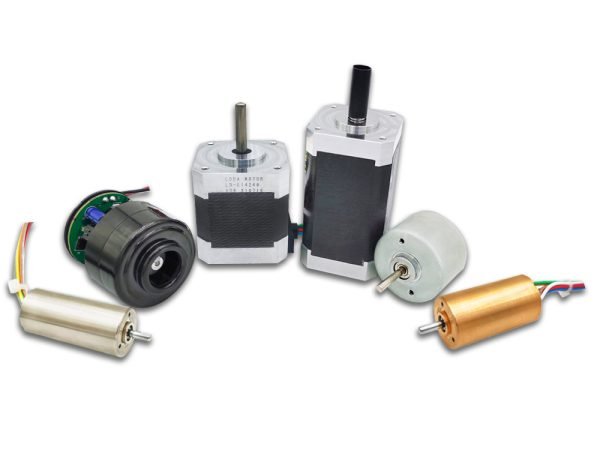
Greater efficiency allows BLDC motors to be made smaller, lighter, and quieter for given power Output, further increasing their popularity in sectors such as automotive, white goods, and heating, ventilation, and air conditioning (HVAC). Other advantages of BLDC motors include superior Speed versus Torque characteristics (except for Torque at start-up), a more dynamic response, noiseless operation, and higher Speed Ranges.
The downside of BLDC motors is their complexity and the associated increase in cost. Electronic commutation demands supervisory circuits to ensure the precise timing of coil energization for accurate Speed and Torque control, as well as to ensure the motor runs at peak efficiency.
BLDC motor basics
All electric motors, whether mechanically or electronically commutated, adhere to the same method of converting electrical energy into mechanical energy. Current through a winding generates a magnetic field, which in the presence of a second magnetic field (typically initiated by permanent magnets) forms a force on that winding that reaches a maximum when its conductors are at 90° to the second field. Increasing the number of coils raises motor Output and smooths power delivery.

A BLDC motor overcomes the requirement for a mechanical commutator by reversing the motor set-up; the windings become the stator, and the permanent magnets become part of the rotor. The stator is typically comprised of steel laminations, slotted axially to accommodate an even number of windings along its inner periphery. The rotor consists of a shaft and a hub with permanent magnets arranged to form between two to eight pole pairs that alternate between ‘N’ and ‘S’. Because the windings are stationary, permanent connections can be established to energize them. For the stationary windings to move the permanent magnet, the windings need to be energized (or commutated) in a controlled sequence to produce a rotating magnetic field.


